
SLO County local news
California Legalizes Plug-In Solar – But You Can’t Plugin Yet
Quick answer
What is happening with California Legalizes Plug-In Solar — But You Can’t Plug One In Just Yet? California has taken a major step toward allowing residents to generate solar electricity… without installing a traditional rooftop solar system. Under newly approved legislation, qualifying small-scale solar systems will eventually be allowed to connect to a home's electrical system through a standard outlet, potentially opening solar generation to renters, apartment residents, condominium owners and homeowners who have never had a practical way to install conventional rooftop panels. But there is an important distinction between California legalizing plug-in solar and Californians…
California has taken a major step toward allowing residents to generate solar electricity…
without installing a traditional rooftop solar system. Under newly approved legislation, qualifying small-scale solar systems will eventually be allowed to connect to a home’s electrical system through a standard outlet, potentially opening solar generation to renters, apartment residents, condominium owners and homeowners who have never had a practical way to install conventional rooftop panels.
But there is an important distinction between California legalizing plug-in solar and Californians being able to go out today, buy a solar panel and plug it into the wall.
They cannot simply do that.
The new framework depends on equipment meeting electrical and product-safety requirements designed specifically for this type of system. Until compliant products are certified and available for use under California’s requirements, the practical rollout of plug-in solar will have to wait.
That safety issue is particularly important because a device capable of feeding electricity into a home’s electrical system is fundamentally different from plugging in an ordinary appliance.
What California has actually changed
Senate Bill 868, known as the Plug And Play Solar Act, creates a pathway for small portable solar systems that can supply electricity directly to a residence without going through the same utility interconnection process normally associated with a conventional rooftop solar installation.
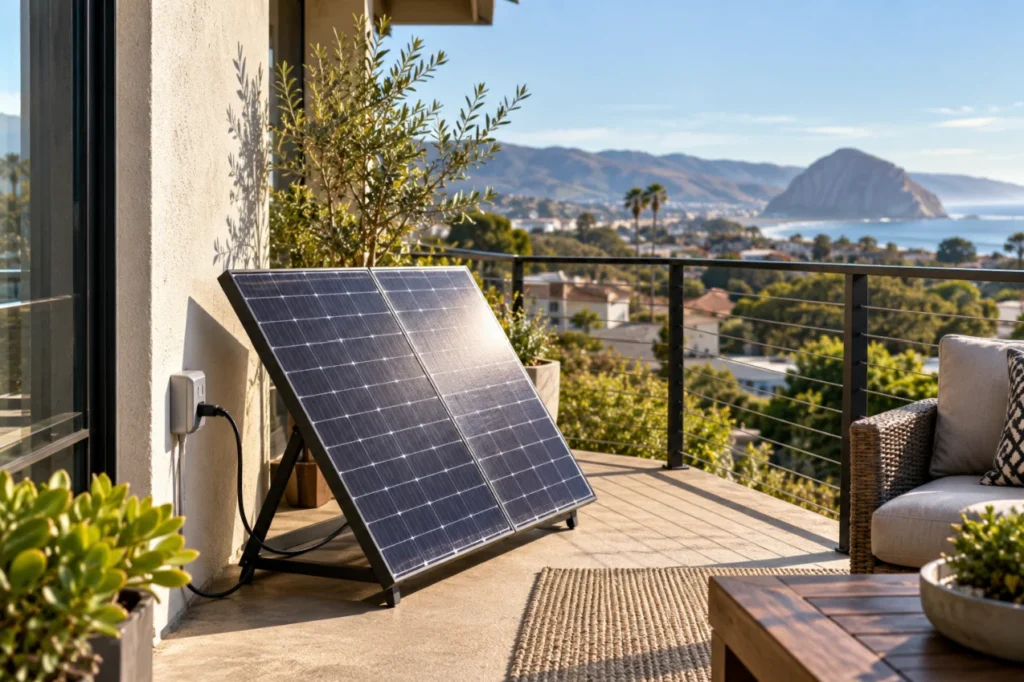
The idea is surprisingly simple. A small group of solar panels produces electricity, an inverter converts that electricity into usable alternating current, and a specially designed system connects that electricity to the home’s electrical system. Electricity generated by the panels can then help supply appliances and other loads operating inside the residence.
These systems are sometimes called plug-in solar, balcony solar or portable solar. The name “balcony solar” comes largely from their popularity in Europe, but a balcony is only one potential location. Depending on the final equipment and installation requirements, a small system could potentially be used on a patio, deck or other suitable sunny location.
California’s legislation is intended to make that type of small-scale generation available to considerably more people, including those who don’t own or control a roof. Senator Scott Wiener’s office has specifically promoted the legislation as a way to expand solar access to renters, apartment residents and homeowners for whom a traditional rooftop system isn’t practical. Senator Scott Wiener
That could make this one of the more significant changes to residential solar in years—not because these systems are particularly large, but because they could substantially lower the barrier to owning solar generation.
Plug-in solar is not the same as plugging in an appliance
This is where some of the early discussion surrounding plug-in solar can become misleading.
A refrigerator consumes electricity from an outlet. A properly designed plug-in solar system does something fundamentally different: it can supply electricity into the home’s electrical system.
That means electrical safety becomes critical.
The electrical system inside a house is protected by circuit breakers, wiring requirements, grounding and other safeguards designed around specific electrical loads and conditions. Introducing another source of electricity into that system has to be done in a controlled manner.
A solar panel by itself does not produce the type of electricity that can simply be fed into a household receptacle. The system requires power electronics, including an inverter, as well as protective equipment capable of safely coordinating the solar generation with the home’s electrical system and the utility grid.
That is why the new California law should not be interpreted as permission to connect an improvised solar generator to a household outlet.
It creates a legal category for equipment specifically designed and certified to operate that way.
The safety standards are the key to making this work
For plug-in solar to become a practical consumer product in California, manufacturers will have to provide equipment that complies with the applicable electrical and product-safety requirements.
This is arguably the most important part of the entire program.
California is not simply removing regulation and hoping for the best. The legislation is intended to replace a cumbersome utility approval process for these small systems with a standardized equipment-safety approach. Senator Wiener’s office has described SB 868 as both establishing safety standards for portable solar devices and eliminating unnecessary utility interconnection requirements. Senator Scott Wiener
That difference matters.
Under the traditional model, a utility can review a particular solar installation before allowing it to interconnect. Under the plug-in model, much more of the safety burden has to be built into the product itself.
In other words, the system needs to be safe because of how it was engineered and certified, rather than because a utility individually reviewed each installation.
That is what can eventually make plug-in solar simple enough for ordinary consumers to use.
One of the biggest concerns is backfeeding the electrical grid
One of the most important protections involves what happens when utility power goes out.
Imagine a utility line serving a neighborhood has been damaged. The utility shuts down that portion of the grid so workers can safely repair it.
If a solar system continued feeding electricity from a house back toward that supposedly de-energized utility line, it could create a serious hazard.
This is why grid-connected solar equipment uses anti-islanding and other protective functions. When utility power disappears, compliant equipment has to recognize the condition and stop energizing the grid.
Plug-in solar cannot be exempt from that basic safety principle simply because the system is small.
A California-compliant plug-in system therefore needs the appropriate protections to isolate itself and prevent unsafe backfeeding during an outage. That capability has to be part of the certified equipment, rather than something consumers are expected to improvise after purchasing it.
This is also why consumers should be cautious about inexpensive solar equipment already being sold online. A product having a solar panel, inverter and household-style plug does not by itself establish that the complete system satisfies California’s requirements.
Certification is what separates plug-in solar from a do-it-yourself experiment
Electrical product certification will play a central role in determining which systems can actually be used under California’s new framework.
Recognized testing and certification standards allow a manufacturer to demonstrate that equipment has been evaluated for its intended use, including the electrical protections required for grid-interactive operation.
That is particularly important with plug-in solar because California is effectively saying that qualifying equipment should not have to go through the traditional interconnection approval process applied to larger solar installations.
For that concept to work safely, consumers, utilities and regulators need confidence that a certified product behaves predictably when connected to a home.
That means controlling voltage and current correctly, responding safely to abnormal electrical conditions and disconnecting appropriately when grid power is lost.
The standards therefore aren’t a minor technical detail standing in the way of implementation.
The standards are what make implementation possible.
That means Californians shouldn’t buy just any plug-in solar system yet
This is probably the most important consumer takeaway.
California’s decision does not mean residents should immediately search online for “balcony solar,” purchase an imported inverter and connect it to a household receptacle.
Existing products may have been designed for electrical systems and regulations in other countries. European balcony solar equipment, for example, exists in a market with different electrical infrastructure and regulatory requirements.
Other products may be designed primarily for off-grid use, portable power stations or battery charging rather than connection to a utility-connected home’s branch circuit.
The physical ability to insert a plug into a receptacle does not make a product compliant.
Consumers will need to look for systems specifically certified for the California and U.S. electrical environment and meeting the requirements established for this new product category.
Until those standards and compliant products are in place, this remains more of a new legal pathway than an immediate plug-and-play option for every California household.
Why this could eventually eliminate a lot of utility paperwork
Once properly certified products are available, the simplicity of the system becomes much more interesting.
Traditional rooftop solar installations can involve building permits, electrical permits, contractor work, utility applications, interconnection agreements, inspections and other administrative requirements. That process makes sense for a large generating system permanently connected to a house, but it can become disproportionate when applied to a few hundred watts of portable solar generation.
That is one of the problems SB 868 is trying to address.
Supporters argue that a small, certified consumer solar device shouldn’t have to go through essentially the same interconnection bureaucracy as a much larger permanently installed system.
The legislation therefore creates a framework intended to remove unnecessary utility interconnection barriers for qualifying portable systems. Senator Scott Wiener
The result could eventually be a system much closer to purchasing an appliance: buy certified equipment, follow the manufacturer’s installation requirements, complete whatever limited registration is required and begin producing a portion of your own electricity.
But the word certified is doing a lot of work in that sentence.
Without standardized equipment and safety protections, eliminating individual engineering reviews would be difficult to justify.
The systems will still be relatively small
Another misconception worth addressing is that plug-in solar will replace conventional rooftop solar.
It won’t.
Traditional residential solar systems are commonly several thousand watts in capacity. Senator Wiener’s office has described typical rooftop systems as roughly 5,000 to 10,000 watts, while plug-in systems occupy a much smaller category. Senator Scott Wiener
The purpose isn’t necessarily to power an entire house.
Instead, a small solar system can reduce the amount of electricity the household needs to purchase from the utility while the panels are producing power.
Suppose a home is continuously consuming electricity for a refrigerator, networking equipment, computers, lighting and other appliances. If a small solar system is producing electricity at the same time, some of that household demand can potentially be supplied locally.
The utility supplies the difference.
Over hundreds of sunny days, those relatively small contributions can add up.
Supporters of the legislation have estimated that some California households could save as much as approximately $450 per year, although actual savings would depend heavily on system size, electricity rates, solar exposure, shading and household consumption. Senator Scott Wiener
Renters may have the most to gain
Traditional residential solar has always had one enormous limitation: someone needs control of the roof.
Millions of Californians don’t.
A renter may pay hundreds of dollars each month for electricity but have virtually no ability to install rooftop solar. Apartment residents face the same problem, as do many condominium owners and people living in buildings where the roof simply isn’t suitable for solar.
Plug-in solar changes that equation because the generating equipment can potentially belong to the resident rather than becoming a permanent part of the building.
A renter with suitable outdoor space could theoretically own a small solar system, use it while living at one property and take it along when moving to another.
That is fundamentally different from rooftop solar.
Instead of requiring property ownership and a major construction project, the entry point could eventually become a suitable sunny location and access to an electrical system compatible with an approved device.
California has roughly 14 million rental units, representing about 40% of households, according to figures cited by Wiener’s office when advocating for the legislation. Senator Scott Wiener
That helps explain why a relatively small solar device could have a much larger policy impact.
The Central Coast could be a natural market
San Luis Obispo County and the broader Central Coast could be particularly interesting places to watch as the technology becomes available.
The region has abundant sunshine but also a diverse housing market that includes single-family homes, apartments, condominiums, manufactured homes, student housing and rentals.
Traditional rooftop solar already makes sense for many properties. But there are plenty of residents who either don’t own their homes, don’t have an appropriate roof or simply don’t want to make the financial commitment required for a large permanent solar installation.
A certified portable system could provide another option.
A renter in Paso Robles with a sunny patio, a condominium resident in San Luis Obispo with appropriate outdoor space or a homeowner in Atascadero who isn’t ready for a full rooftop system could all potentially represent the type of consumer this technology is intended to serve.
That does not mean every patio or balcony will automatically be suitable. Shading, panel orientation, mounting, leases, homeowner association restrictions and the home’s electrical configuration can all affect whether a particular installation is appropriate.
But the fundamental difference is that those consumers could finally have an option worth evaluating.
Plug-in solar also shouldn’t be confused with backup power
Another likely source of confusion is the relationship between portable solar and portable batteries.
They are not the same thing.
Solar panels generate electricity when sunlight is available. Batteries store electricity so it can be used later. Some consumer systems combine both technologies, but a plug-in solar device does not automatically provide backup power during an outage.
In fact, the safety requirement to prevent uncontrolled backfeeding means a basic grid-interactive system generally needs to stop supplying the grid when utility power disappears.
Consumers who want emergency power will need to look specifically at equipment designed and certified to provide that function safely.
As this market develops, manufacturers will likely offer combinations of solar panels, batteries, energy management and backup capabilities. But buyers will need to understand exactly what a particular system is certified to do.
“Plug-in solar” should not become shorthand for “whole-home emergency power.”
California is following a trend already well established in Europe
Plug-in solar isn’t an entirely new idea.
Germany has become one of the best-known examples of widespread balcony solar adoption. Senator Wiener’s office said earlier this year that more than one million such systems had been installed there. Senator Scott Wiener
The European experience helped demonstrate that residential solar doesn’t always need to mean a large rooftop array.
California’s involvement could now have an outsized impact on the American market.
Manufacturers have a strong incentive to build products for a state with nearly 40 million residents, particularly when that state establishes a clear legal framework for using the equipment.
If manufacturers develop certified products specifically for California’s requirements, those same designs could eventually make plug-in solar easier for other states to adopt.
California has influenced national product markets in similar ways before: a sufficiently large market can make it worthwhile for manufacturers to engineer products around the state’s requirements.
The next phase is about engineering, standards and certification
The signing of the legislation makes for a good headline, but the less exciting work that follows may ultimately determine whether plug-in solar succeeds.
Manufacturers need compliant designs. Testing organizations need appropriate certification pathways. Electrical-code requirements need to be satisfied. Utilities need to prepare whatever streamlined registration processes are permitted. Retailers will need a reliable way to distinguish compliant systems from products that merely look similar.
Consumers will also need clear labeling.
Someone shopping for one of these systems shouldn’t need to become an electrical engineer to determine whether it is legal to connect to a California home.
Ideally, the eventual consumer experience will be straightforward: the product is clearly identified as certified for the intended application, installation instructions define exactly where and how it can be connected, and the equipment contains the protections necessary to operate safely without a traditional utility engineering review.
Getting to that point is what the standards process is supposed to accomplish.
Until then, California has created the pathway, but the technology cannot simply be implemented everywhere overnight.
A small change that could reshape residential solar
For decades, California’s solar expansion has largely meant two things: enormous utility-scale solar farms and permanently installed rooftop systems.
Plug-in solar introduces a third category.
Small. Portable. Consumer-owned. Potentially affordable. And, perhaps most importantly, accessible to people who don’t own a roof.
That doesn’t mean a small portable system will make a household energy independent. It won’t replace conventional rooftop solar where a larger system makes sense, and it won’t solve California’s electricity affordability problem by itself.
What it could do is give millions of residents another way to participate in solar generation.
The significance of SB 868 is therefore not simply that California is allowing solar panels to connect through an outlet. It is that the state is trying to create a standardized consumer product category where the engineering and safety protections are built into certified equipment rather than recreated through an expensive interconnection process for every household.
If manufacturers and standards organizations get that part right, the technology could eventually become remarkably ordinary.
Buying a small solar system may someday feel less like beginning a construction project and more like buying another piece of household energy equipment.
California has now created the legal framework for that future.
But it isn’t here quite yet.
The standards, certifications and compliant equipment have to come first.
Editor’s Note: California’s new plug-in solar framework should not be interpreted as authorization to connect arbitrary solar panels, inverters or imported “balcony solar” equipment to a household outlet. The legislation is designed around qualifying equipment meeting applicable safety requirements. Consumers should wait for equipment specifically certified for use under the California framework and follow the manufacturer’s instructions and any applicable electrical, property or registration requirements. SLOpulse will continue following the rollout as compliant products and implementation guidance become available.
Comments and community engagement live on Reddit rather than on this site.
No Responses